The short version
- Choose a task → Build evidence → Apply honestly.
- Keep source evidence and review the result before using it.
To get a job in AI, start with a type of work you can demonstrate. Engineering, evaluation, data quality, and product operations require different evidence. Choose a task family, inspect actual role requirements, and build a small project that shows how you work.
You do not need to choose a title before understanding the tasks. An “AI specialist” posting may describe software development, quality review, customer implementation, or a mixture. Read the responsibilities and expected outputs before planning your preparation.
Choose a task family
Direction | Work to inspect | Evidence you could build |
|---|---|---|
AI engineering | Implement and maintain model-backed software | A tested application with documented limits |
Evaluation | Compare or label outputs against guidelines | Rated examples with a rubric and review notes |
Data quality | Inspect and prepare records | A cleaning report with reproducible checks |
Operations | Coordinate a repeatable process | A workflow with owners and escalation rules |
Product work | Define a problem and evaluate an approach | A decision memo with user needs and acceptance criteria |
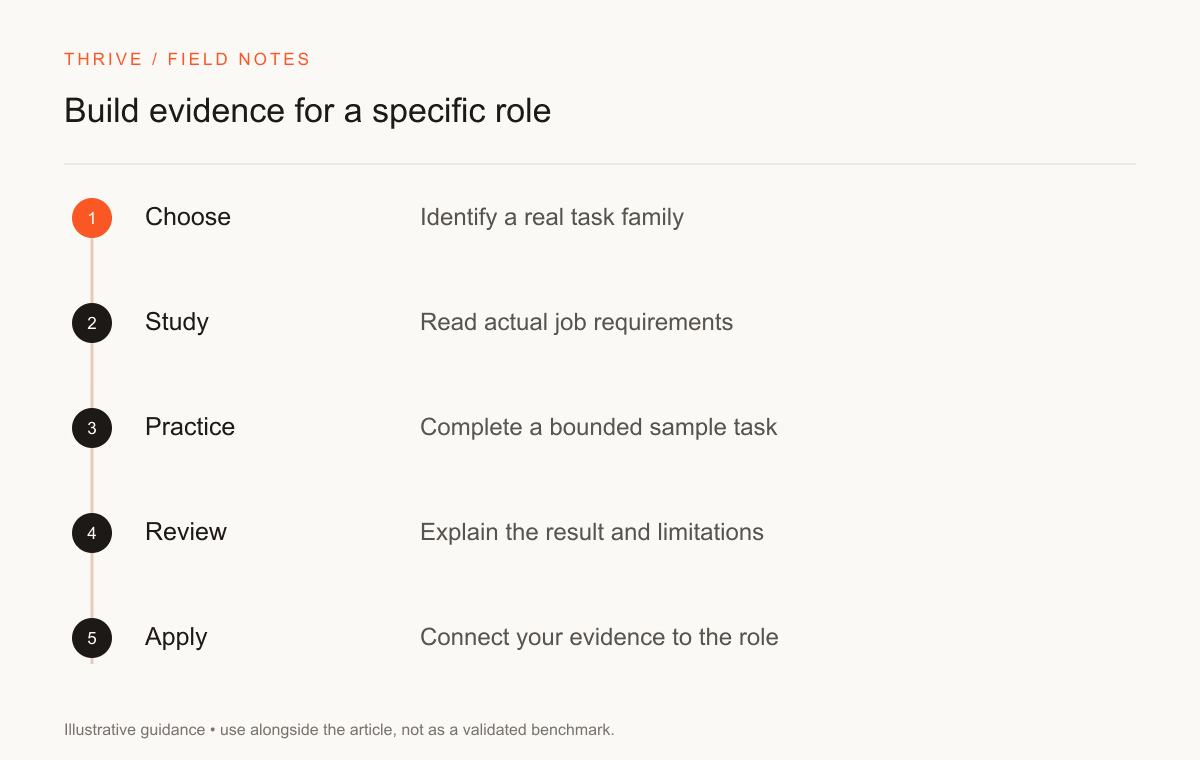
The O*NET data scientist and software developer profiles provide occupational task references. Employer postings define the particular role you apply for. Do not infer entry requirements from a broad occupational label.
Read several genuine postings
Find original employer listings rather than relying on a generated summary. Record tasks, required experience, preferred tools, location conditions, and the application process. Check whether the listing remains open.
Look for recurring tasks across the roles you want. A task repeated in your small sample can guide your preparation. It does not establish a market-wide demand statistic.
Separate a requirement you meet from one you can learn. Keep your gaps visible. A resume that claims the entire posting creates problems when an interviewer asks you to demonstrate the work.
Build one project with an inspectable result
For evaluation, select a public or fictional source set and compare responses against a rubric. Define correctness, relevance, and appropriate escalation. Preserve a tie where the evidence does not distinguish the responses.
For data quality, use a dataset you can share. Define valid values, missingness rules, and checks for duplicate records. Show the original issue and the effect of your cleaning decision. Keep a case where the correct decision requires more information.
For engineering, build a bounded feature and test it. Record the environment, data inputs, failure cases, and permissions. A demonstration should let a reviewer understand what happens when the model returns an invalid answer.
Use the model evaluation workflow, data quality skill, or debugging workflow as instructions. Your completed artifact demonstrates practice; the downloaded workflow does not establish a credential.
Write a project record a reviewer can follow
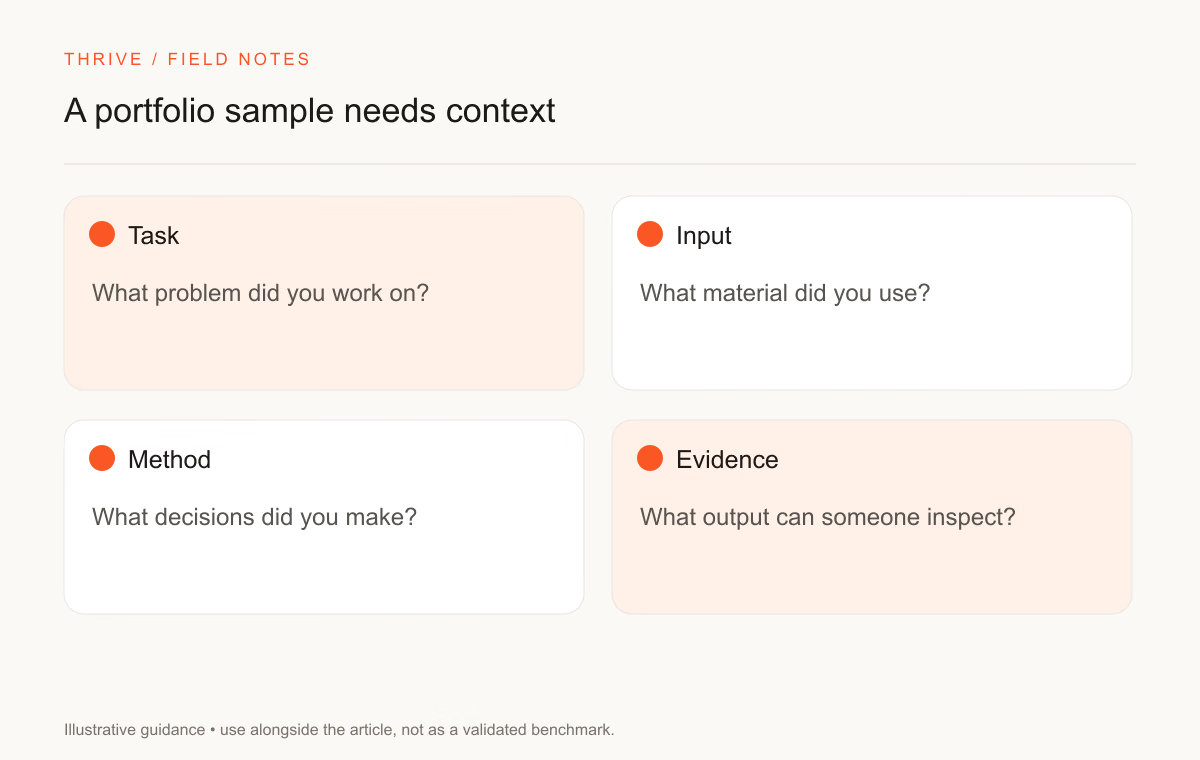
State the question, inputs, method, checks, result, and limits. Distinguish your decisions from the assistant's suggestions. Include failures that changed your approach.
Portfolio section | Question to answer |
|---|---|
Context | What problem did you choose, and for whom? |
Contribution | Which decisions and tasks were yours? |
Method | How did you organize the work and use tools? |
Evidence | Which artifact or test supports your result? |
Limits | What did the project leave unresolved? |
Use a de-identified example you have permission to publish. Keep confidential employer exercises and customer records out of a public portfolio.
Prepare a truthful application
Select experience relevant to the posting. Describe practice work as practice work, coursework as coursework, and employment as employment. Preserve dates, qualifications, and ownership.
Use the resume tailoring guide to map requirements to evidence. Build the application in the resume workspace, and create a cover letter if the employer requests one.
The career transition prompt can help organize a learning plan around existing strengths. Check its suggestions against genuine role requirements and the time you can commit.
Practice the interview as a review of your decisions
Explain one example without reading a generated answer. Describe the task, the evidence you used, the alternatives you considered, and a mistake you corrected. Prepare to show how you verified the output.
For an evaluation role, practice a disagreement. You can rate the same response differently under two rubrics; explain which rubric belongs to the task and why. A useful discussion includes uncertainty and escalation rather than confidence alone.
Use the AI interview guide for practice topics. Thrive's readiness assessment suggests role fit and an illustrative salary range from scenario answers. Compare the result with an employer's requirements; it does not establish your qualification or compensation.
Verify the opportunity before sharing information
Confirm the employer, application domain, and eligibility. Read the contract and payment arrangement. Treat an upfront payment demand or a request to move money as a reason to investigate before proceeding.
The FTC job-scam guide describes common risks. Use the Thrive job-search checklist to maintain a source and version record. Check published jobs when available, without assuming the page contains a role for your location.
Choose a project size you can finish
A useful first project has one reader and one acceptance rule. For an evaluation sample, the reader might be a reviewer checking whether you applied a rubric consistently. For a software sample, the acceptance rule might be that a user can correct an invalid generated field before saving it.
Write the boundary before you begin. List what the project will do, what input it needs, and what you will leave out. If you plan a resume assistant, you could limit the first version to identifying claims that lack supporting notes. That lets you evaluate a specific behavior without building payments, accounts, document export, and every possible resume template.
Keep a short list of decisions. Record why you selected a source, rejected an output, or changed a rule. You will forget these details if you only retain the final screenshot. The decision record also helps distinguish your work from the model's contribution.
A worked evaluation portfolio plan
The following plan is a fictional practice project for someone interested in response evaluation. It uses made-up workshop notices rather than employer documents. No model performance is claimed.
Project choice | Proposed scope | Evidence to publish |
|---|---|---|
Question | Does each response preserve the notice's factual details? | The exact instruction and reference notice |
Input set | Six short notices with ordinary, missing, and conflicting details | The invented notices, labeled as practice data |
Rubric | Check dates, locations, deadlines, and unsupported additions | Definitions with an example for each criterion |
Review | Compare two responses for each notice and allow ties | Ratings with sentence-level reasons |
Revision | Clarify a rule that produced an ambiguous decision | The original rule, revised rule, and affected case |
Limitation | The sample is small and covers one task type | A note about what the exercise cannot establish |
Begin by writing a correct reference for each notice. Generate or write the candidate responses, then rate them without relying on the model label. A response that invents a room number should fail the factual-detail check even if its wording is concise.
For the difficult case, give the notice two different deadlines. A reviewer should identify the conflict rather than choose the more convenient date. If your first rubric does not explain how to rate that answer, revise the rule and record the reason. That revision is part of the work sample.
Ask someone else to apply your instructions to one case. Compare the reasons, not only the labels. You may discover that a term such as "minor error" needs a clearer definition. Preserve the disagreement and explanation instead of presenting artificial agreement.
The AI evaluator guide includes a smaller worked comparison. The prompt engineering guide explains how to keep the assignment, input, and review rule distinct.
A software project should show failure handling
If you want an engineering role, build something that handles a model's imperfect output. A small document-extraction interface is one option. The user supplies public sample text, the assistant returns a structured result, and the application checks required fields before displaying it.
Include an invalid response in your tests. The model might omit a field, return the wrong type, or cite a passage that does not support its answer. Your application should show a recoverable error or a review requirement rather than quietly saving the result.
Document the model call separately from the rest of the application. Show which input reaches the model, where validation happens, and which actions require user approval. Keep API keys outside the client bundle and public repository. Use your framework's current documentation for the implementation and inspect generated commands before running them.
A reviewer should be able to follow your setup steps and reproduce a result with sample inputs. Include a cost or usage note only when you have measured it or clearly label it as a calculation. Do not claim production scale from a local demonstration.
Translate your existing experience into task evidence
You may already have relevant examples outside an AI job title. Look for decisions you made, outputs you produced, and checks you performed. Keep the original context visible when you describe the connection.
Existing work | Possible connection to an AI task | Evidence you would need |
|---|---|---|
Reviewed written instructions | Check clarity and instruction following | A permitted example and your review notes |
Resolved inconsistent spreadsheet records | Data quality and exception handling | The rules you used and a reproducible check |
Explained a subject to learners | Review explanations for accuracy and audience | A worked example and a reference |
Coordinated approval steps | Human review in a workflow | A process map with responsibilities |
Debugged an application | Inspect model-assisted code changes | A failure case, diff, and passing test |
These connections suggest questions to investigate. They do not replace an employer's qualification requirements. If a posting asks for a particular language, degree, or commercial experience, state whether you have it. Use a practice project to demonstrate learning, without presenting it as equivalent employment.
Prepare for four kinds of interview questions
For a task explanation, choose one completed example and describe the input, output, and check. Avoid giving a broad definition when the interviewer asks what you actually did.
For a mistake, explain an output you initially accepted and the evidence that changed your decision. Show the correction. You can discuss a practice mistake if you identify it as one.
For a tradeoff, compare two approaches to your project. You might choose a smaller source set because it allowed careful review, or keep a step manual because the consequence of an incorrect write was too high. Explain the decision with the project's constraints.
For an unfamiliar task, ask what output is needed and how it will be evaluated. State what you know and what you would verify. Inventing an answer to appear confident gives the interviewer less useful information about your judgment.
Read any take-home exercise's rules before using AI assistance. If tool use is restricted, follow that restriction. If assistance is permitted, retain a record of what it produced and what you checked. Do not publish the employer's confidential exercise in your portfolio.
Keep applications and learning in the same feedback loop
Create an application record with the employer's original URL, the date you checked it, the role's requirements, and the resume version you submitted. Add the outcome when you receive it. A separate learning column can record the next task you need to practice.
After several applications, look for concrete evidence. Repeated postings that ask for a tool you cannot demonstrate suggest a learning project. An interviewer asking how you checked a result suggests that your portfolio needs a clearer review section. A rejection with no feedback does not reveal the employer's reasoning.
Keep location research specific. Check the posting's eligible countries, work arrangement, time-zone expectations, and application instructions on the employer's site. O*NET's occupational references concern the United States; they are not a substitute for local qualifications or an employer's requirements elsewhere.
Use the AI career roadmap to plan the next project, then revisit your application evidence. A small completed task, a clear review record, and a truthful explanation give you something concrete to improve.
Sources and review notes
Thrive Editorial reviewed these sources on September 28, 2026. Project ideas are illustrative preparation tasks. We make no placement, demand, or salary promise from this guide.
Put it into practice
Your next step
Try a prompt
Prompt libraryCareer Transition RoadmapRead next
Related guideAI Career Roadmap: Choose a Role, Practice, and Build a PortfolioRelated guidePrompt Engineering Guide: A Testable Method and 50 Practice PromptsRelated guideHow to Tailor Your Resume to a Job Description with AIRelated guideWhat Does an AI Evaluator Do? Tasks, Rubrics, and a Worked ExampleHave a question or a correction?
Contact Thrive