
The short version
- Small task → Tested diff → Human review.
- Keep source evidence and review the result before using it.
Choose the best AI for coding by testing a change in the kind of repository you maintain. Give the assistant a concrete requirement, a fixed code snapshot, and a test command. Review the diff and run the checks before deciding whether the tool saves you work.
A model, an IDE assistant, and a coding agent provide different levels of access. An agent may edit files and run commands; a chat session may produce code for you to copy. Compare the complete workflow you intend to use.
Start with the model and the surrounding tool
OpenAI documents GPT-6 Sol for coding and agentic work, with Astra and Luna serving different cost and capability needs. Anthropic documents Opus 5.5 for agentic coding and knowledge work. Those provider descriptions identify possible candidates, not a winner for your repository.
Candidate | Provider's positioning | Trial to run |
|---|---|---|
GPT-6 Sol | Coding and agentic workflows | A failing test and a scoped implementation |
GPT-6 Astra | Complex reasoning and coding | A change with several interacting constraints |
GPT-6 Luna | Focused, high-volume work | A bounded transformation with automated checks |
Claude Opus 5.5 | Agentic coding and knowledge work | A repository task with reviewable milestones |
Sources: OpenAI's model catalog and Anthropic's model overview. Review current access, usage limits, and pricing for the product you choose. This guide does not report completed benchmark results.
Build a repository-specific test set
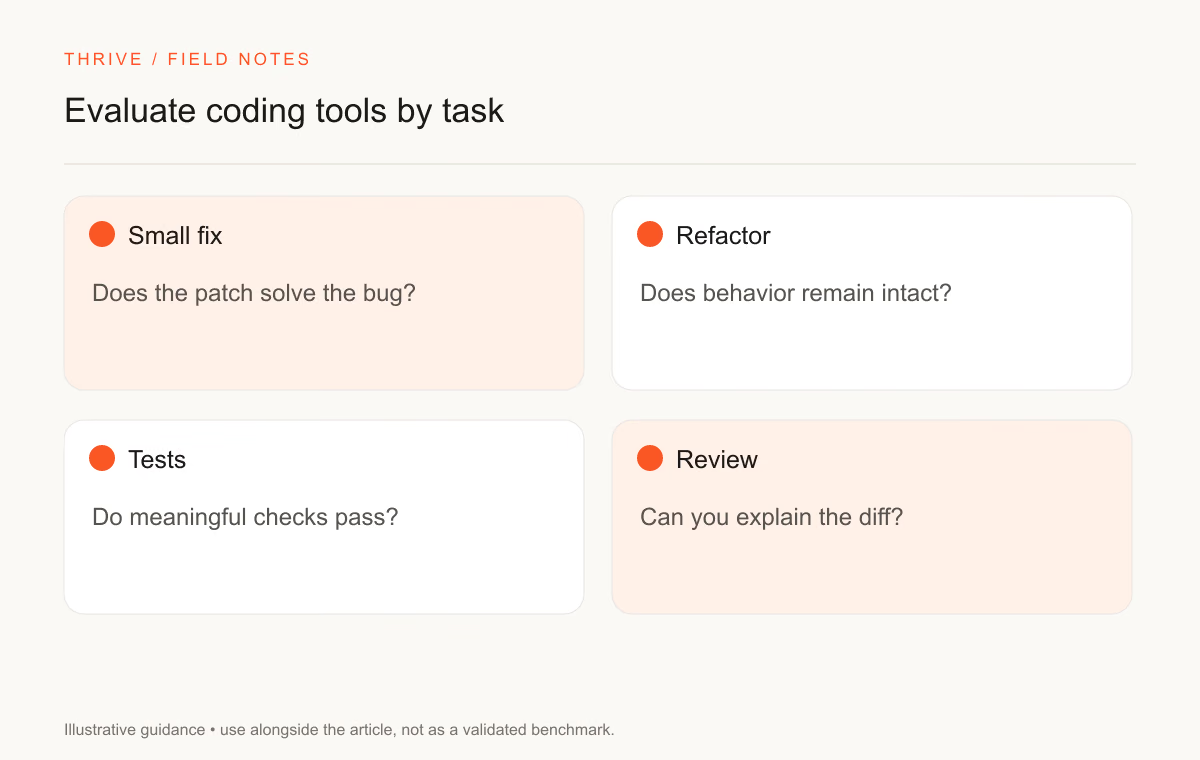
Choose examples from the work you repeat. Include a defect, a small feature, and a review task. Add at least one case where a tempting shortcut would break an important constraint.
Use a clean branch and preserve the starting commit. Provide the same instructions and permitted tools to each candidate. Record the model, effort settings, context supplied, and commands the assistant runs.
Task | Acceptance check | Failure to record |
|---|---|---|
Bug fix | Reproduction fails before the change and passes after it | The assistant hides the failure |
Feature | Required behavior works and old behavior stays intact | Unrequested API changes |
Refactor | Tests and interfaces remain stable | Broader edits without a reason |
Code review | Findings include a reproducible issue | Unsupported warnings about hypothetical defects |
Documentation | Examples match the actual API | Invented flags or signatures |
A debugging workflow can structure the first case. For TypeScript, use the architecture audit prompt to make the review scope explicit.
Keep permission boundaries visible
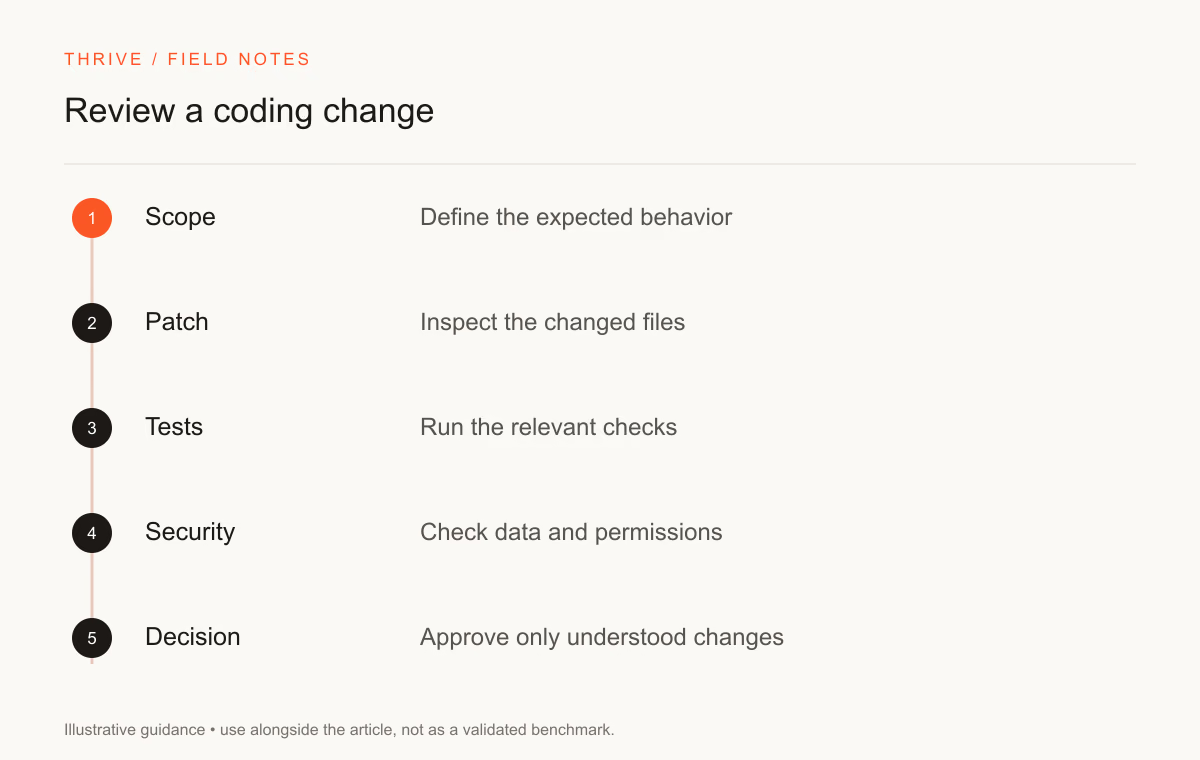
Limit the assistant to the repository and commands it needs. Keep credentials out of prompts and logs. Review a proposed package installation, database mutation, or external action before allowing it in a test environment.
Read the diff before running generated code against sensitive systems. A passing unit test does not establish safe behavior for a deployment command or a database migration. Separate local implementation from release approval.
For a repository with user data, include an ownership or authorization test. A feature that passes a happy-path test can still let one account read another account's records.
Measure review effort alongside usage cost
Record time spent correcting the output, not only time until the first response. A quick patch that requires extensive repair may cost more attention than a slower, usable one. Note where you had to explain the requirement again.
API charges depend on tokens, service conditions, and tools. IDE or agent subscriptions may apply their own limits. Use your actual usage record and current provider pricing to calculate cost per accepted task.
Preserve failed attempts in the record. Removing them after the test can make a tool look more reliable than it was. Keep ties where you cannot distinguish the outputs under your rules.
Select a default and an escalation path
After a pilot, choose a default for a defined class of work. You might use one candidate for short transformations and another for a difficult repository investigation. Re-test after model updates or changes to your codebase.
The Sol versus Opus coding protocol gives you a detailed comparison worksheet. The GPT-6 family guide covers routing tasks within OpenAI's model family.
Turn a de-identified evaluation into a portfolio entry: state the task, starting condition, checks, and result. Use the code-review skill and resume builder to document the contribution without claiming a benchmark you did not run.
Sources and review notes
Thrive Editorial reviewed these sources on September 28, 2026. The acceptance checks are an original proposed framework, not evidence that Thrive tested the named models.
Put it into practice
Your next step
Have a question or a correction?
Contact Thrive