
The short version
- Record the permalink, timestamp, context, and collection date for each observation.
- A public profile is a partial activity record, not proof of identity or sensitive traits.
Reddit user profile information extraction starts with a narrow question and a source log. You can inspect an account's public posts and comments, but a profile is a partial record of activity, not proof of the person's identity or private circumstances. The sound technique is to collect only relevant public material, keep a URL and timestamp for each observation, and separate the account's words from your interpretation.
Decide what you need to learn
Suppose you are studying how members of a software community discuss onboarding problems. “What themes appear in this account's public contributions to that community during September?” is answerable. “Who is this person, and what do they really believe?” is neither a useful research scope nor a conclusion that a Reddit profile can support.
Write down the account URL, communities, date range, and intended use before collection. If you are reviewing your own account, you can broaden the scope. If you are analyzing somebody else's activity, minimize the sample and avoid sensitive profiling. Public visibility does not remove the need to follow Reddit's Data API Terms and Developer Terms.
Research question | Collect | Leave out |
|---|---|---|
Repeated onboarding complaints in one community | Relevant posts and comments, thread URLs, dates, surrounding replies | Unrelated communities and personal details |
A moderator's review of a reported exchange | The reported comments, parent comments, rule context, edit or removal state | Speculation about the account holder |
Your own account audit | Your accessible posts, comments, and export records | Claims about deleted material you cannot verify |
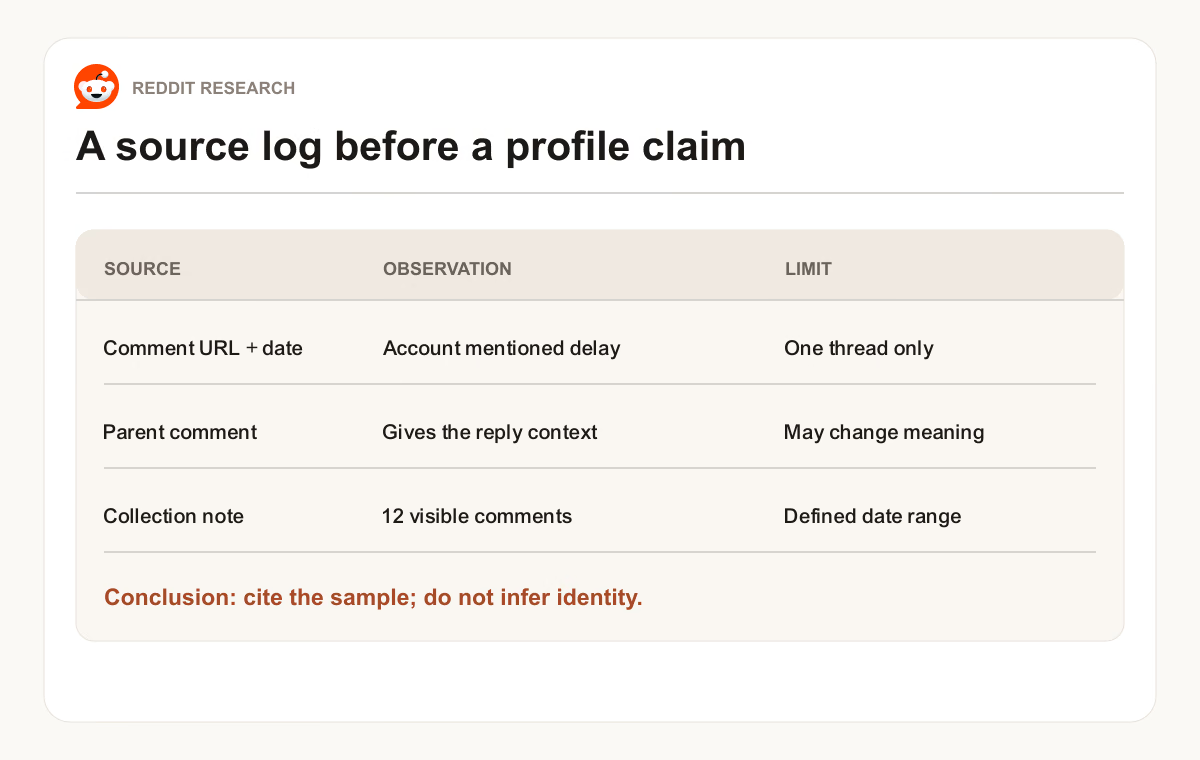
Build an evidence ledger
For each item, record its permalink, community, UTC timestamp, collection date, type (post or comment), and the short passage you actually need. Add a context column. A reply saying “that fixed it” means little without the parent comment. If the item was edited, removed, or unavailable when you checked it, note that rather than filling the gap from memory or an old excerpt.
Use the public interface for a small manual review. For repeated collection, consult the Reddit API documentation and confirm that your application has the access and use rights it needs. An API response can make collection reproducible; it does not make the sample complete. Pagination, sorting, account deletions, access limits, and the date you collected the data all shape what you can see.
The ledger can stay simple:
Field | Example entry | Why it matters |
|---|---|---|
Source | Comment permalink | A reader can inspect the original context |
When | Posted 2026-09-18 UTC; checked 2026-10-05 | Activity and collection are different dates |
Observation | “The setup email arrived late” | A direct statement, not a profile trait |
Interpretation | Delivery friction appeared in two relevant threads | Bounded claim tied to a count |
Limit | One community, one month, visible comments only | Prevents a general claim about the person |
Separate extraction from inference
A post title, flair, comment, and thread reply are different kinds of evidence. Quote the account's own words only when they are necessary and attribute them to that account. A third party's characterization of the user belongs in a different column. If an account says “I work in design,” you can report that the account stated it. You cannot verify employment from the statement alone.
Count only the items in your defined sample. “Six of 18 reviewed comments mention setup friction” tells the reader more than “the user often complains.” Record the denominator, the review period, and whether you selected the sample by date, community, or keyword. If one long thread dominates the count, point it out.
Avoid linking a pseudonymous account to a real name or inferring health, politics, location, or other sensitive traits from writing style and communities. Such guesses are easy to overstate and can harm the account holder. A legitimate consent-based investigation may require more evidence and a different process; this guide does not turn a public comment history into permission to identify someone.
Use a repeatable research prompt
After collecting permitted source links, give an assistant a bounded task: “Review these 12 public Reddit comments from September. List recurring onboarding issues, quote no more than one short phrase per theme, cite each permalink, and mark any interpretation as an inference. Do not infer the author's identity or sensitive traits. Tell me what this sample cannot establish.” Check every cited URL and count yourself before sharing the result.
The Reddit Profile Research skill turns that method into a reusable checklist. For broader source synthesis, the Research Summarizer skill can help organize findings after collection.
Keep the output proportionate
Share the question, date range, collection method, evidence table, and a short conclusion. Note missing context and removed material. Keep raw copies only as long as the legitimate task requires, and revisit Reddit's current terms before automating retention or reuse. A useful profile analysis ends where the evidence ends.
Common questions
Can I use a scraper instead of Reddit's API?
Check the current Reddit terms and the access route allowed for your purpose before building a collector. A scraper that bypasses limits or recovers deleted content creates a different problem from a manual review of visible posts. The source log and interpretation limits still apply to any permitted collection method.
Can an account's comment history identify its owner?
The history can show what that account posted in the visible sample. It cannot, by itself, verify a real-world identity. Similar usernames, self-descriptions, and writing habits can mislead. Keep an account-level finding at the account level unless you have a separate, legitimate basis to make an identity claim.
Put it into practice
Your next step
Have a question or a correction?
Contact Thrive